How Often Should You Get Assisted Stretching? A Realistic Guide
"How often should I actually book?" is one of the most common questions we hear — and the honest answer depends less on generic advice and more on one specific thing: how tight you actually are right now.
How often should you get assisted stretching? As a starting point: if you're very tight, weekly sessions for the first couple of months make the biggest difference. If you're moderately tight, weekly for a shorter stretch or fortnightly works well. If you're already fairly flexible and just want to stay that way, fortnightly to monthly sessions are usually enough. From there, frequency naturally tapers down as your body responds.
The Flexibility & Mobility Plan
Rather than a one-size-fits-all answer, we work off a simple three-phase framework based on your starting point. We look at how tight you are and what stage of progress you're at.
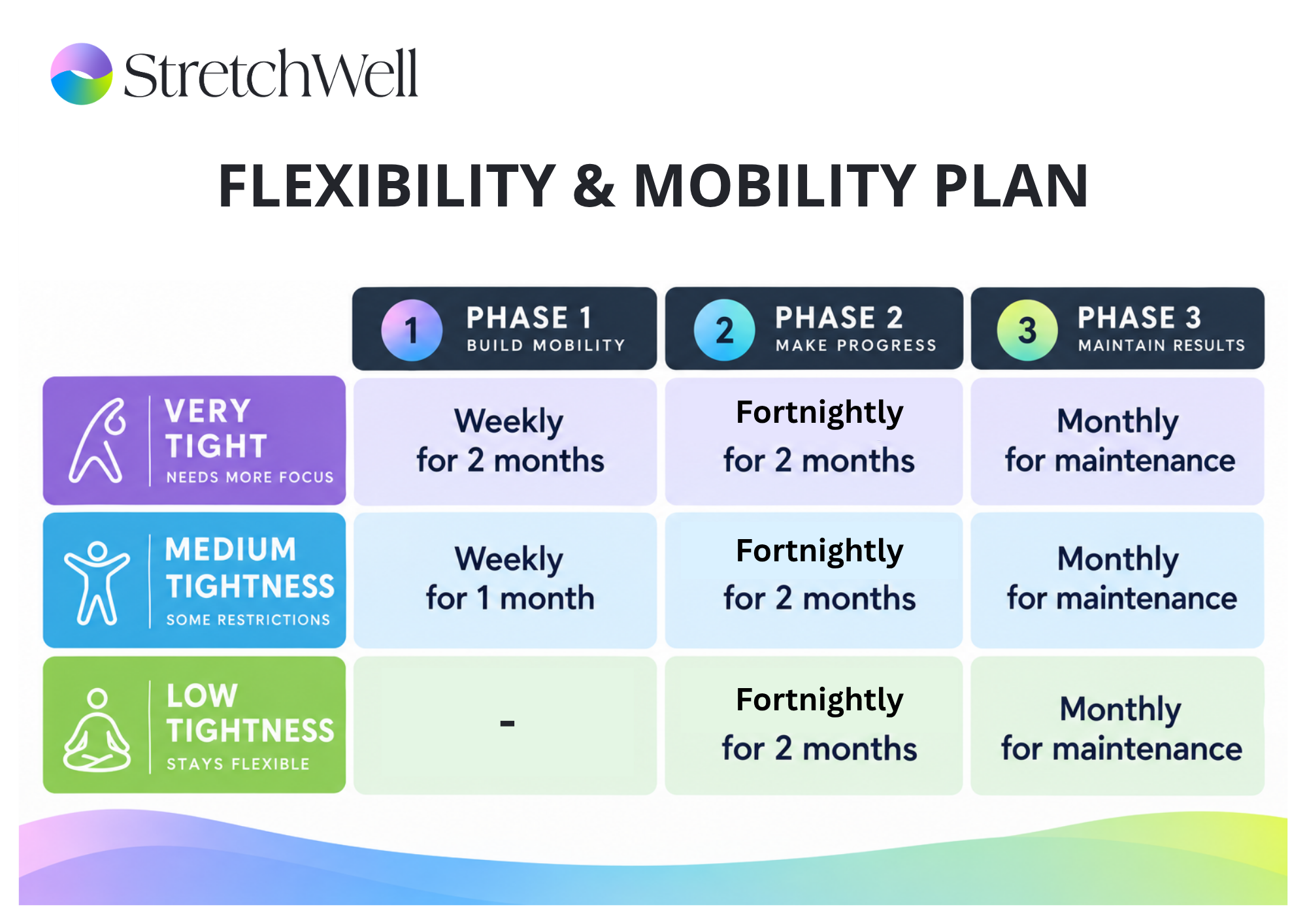
Phase 1: Build Mobility
This is where the real change happens, and it's also where consistency matters most.
Very tight: weekly sessions for 2 months
This ensures you develop a basic level of mobility and flexibility. By being consistent with weekly sessions, your body is able to adjust and get used to moving outside it’s normal range of motion.
Medium tightness: weekly sessions for 1 month
You already have some level of flexibility but still some tightness. By stretching weekly for 1 month at least, this will get your body to a place where you only need to focus on monthly maintenance.
Low tightness: you can generally skip straight to Phase 2 as you already have some flexibility.
Phase 2: Make Progress
Once your body has responded to that initial, more frequent phase, sessions can space out while you continue building on the progress you've made.
Very tight: fortnightly for 2 months
This shows your body that you still need to be able to lengthen your muscles and tissue when you need to, without having to visit every week.
Medium tightness: fortnightly for 2 months
Low tightness: fortnightly for 2 months (this is where a low-tightness starting point typically begins)
Phase 3: Maintain Results
Once you've reached a comfortable, consistent range of motion, the goal shifts from building progress to simply maintaining it.
All tightness levels: monthly sessions for ongoing maintenance
Monthly maintenance is all you need once your body is where you want it in terms of mobility, flexibility and range of motion. The weekly stretching in phase 1 and 2 got you to where you wanted to be, and now you just need to continue to use your body to show it why it needs to stay that way.
Why This Structure Actually Works
Flexibility gains build through consistent, repeated sessions early on, then become easier to maintain with less frequent work once your body has adapted. Starting too infrequently when you're very tight means you're constantly fighting to regain the same ground each session, rather than building on real progress — which is why the "weekly at the start" recommendation matters more than it might seem for anyone starting from a very tight baseline.
Which Option Actually Matches Your Phase
Here's how this framework lines up with what you'd actually book:
If you're in Phase 1 or 2 needing weekly or fortnightly sessions: a StretchClub membership is built for exactly this. Essential (2 sessions/month) suits a fortnightly cadence, while Ultimate (4 sessions/month) matches a weekly Phase 1 schedule for someone very tight — and locks in our lowest per-session rate for the months you'll actually be using it most.
If you're moving into Phase 3, maintaining monthly: a membership's minimum term may be more commitment than you need at this stage. This is where a package (5, 10 or 20 sessions) often makes more sense — pay once, use your sessions at a monthly pace, no ongoing commitment.
If you're not sure yet where you sit: that's completely normal, and exactly what your first session is for. Your therapist will assess your current tightness and talk through a realistic plan from there, rather than you having to guess.
A Realistic Note on Consistency
It's worth being honest: the biggest factor in how much difference assisted stretching makes isn't really the exact frequency you choose — it's whether you actually stick with it during that first, more intensive phase. Most people see the most noticeable change in Phase 1, and it's very common to feel tempted to space sessions out too early once you start feeling looser. Sticking with the recommended cadence through the full first phase tends to produce far more lasting results than a shorter burst followed by long gaps.
Getting Started
If you're not sure whether you're "very tight" or "medium tightness," don't worry about self-diagnosing — book a first session, and your therapist will help you figure out where you actually sit and what a realistic plan looks like from there.
Book your first assisted stretching session at StretchWell in Northcote, and we'll help you map out the right frequency for your body.
FAQs
How often should I get assisted stretching if I'm very tight? Weekly sessions for around 2 months is the recommended starting point, moving to fortnightly for another 2 months as you progress, then monthly for maintenance.
How often should I get assisted stretching for general maintenance? Once you've built up your flexibility, monthly sessions are generally enough to maintain your results.
Should I get a membership or a package? If you're in the earlier, more frequent phases (weekly or fortnightly), a StretchClub membership usually offers the best value. Once you're maintaining monthly, a package with no ongoing commitment often suits better.
How do I know which tightness category I'm in? You don't need to work this out yourself — your therapist will assess this during your first session and help you plan a realistic frequency from there.
What happens if I space my sessions out too early? It's common, but it tends to slow down how much progress you actually make. Sticking with the recommended frequency through the full first phase generally produces more noticeable, lasting results.
Related Posts