Golf Stretches to Improve Your Swing (and Speed Up Recovery)

Why your swing might be a mobility problem
Most golfers try to fix a bad swing with more lessons, a new driver or another bucket of balls at the range. Fair enough. But if your hips won't rotate and your upper back is locked up, no amount of practice will get you into the positions your coach keeps asking for.
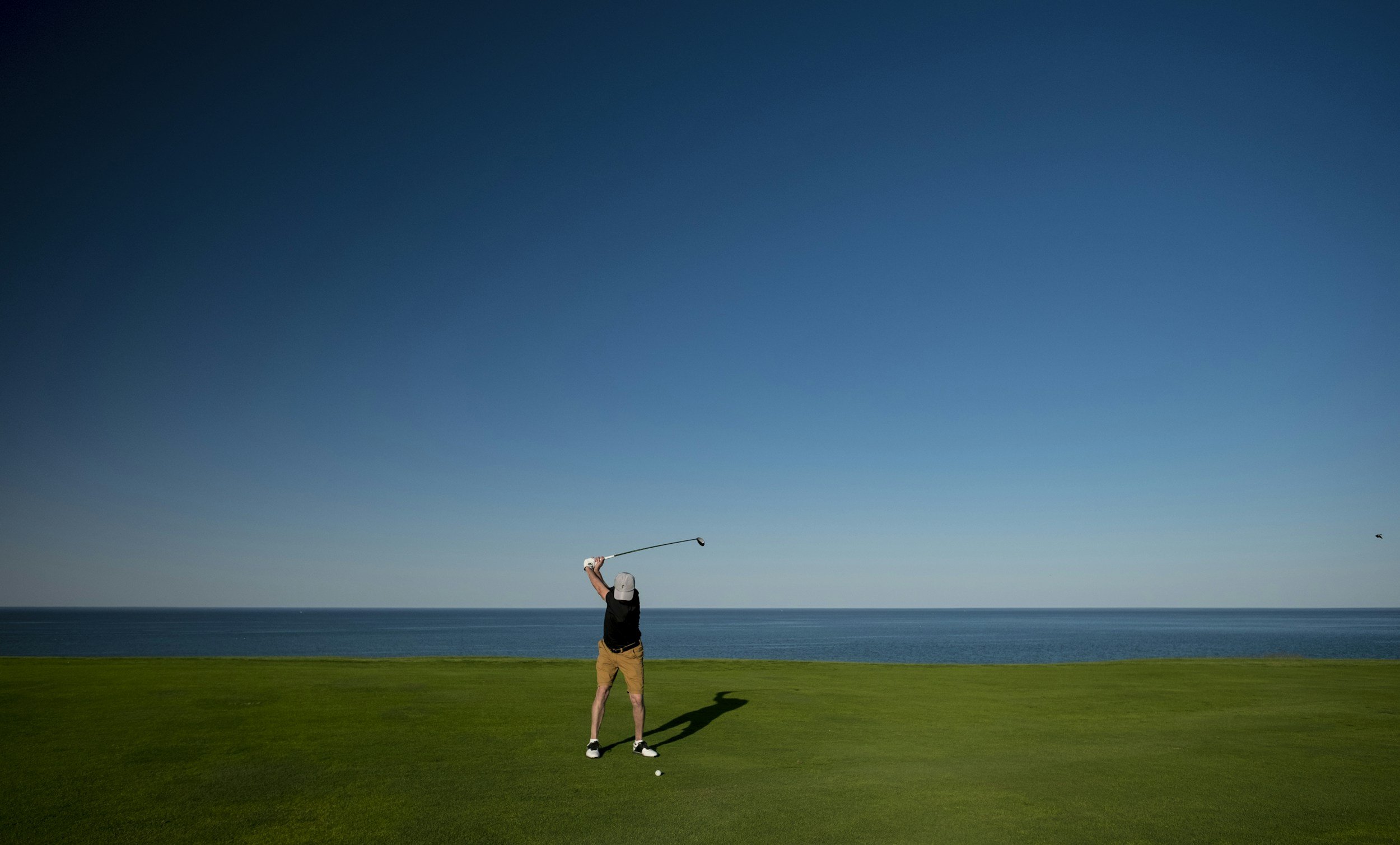
The golf swing is one of the most demanding rotational movements in sport. In a couple of seconds your body has to coil hard through the hips and upper back, stay stable through the lower back, then unwind fast without losing posture. When one link in that chain is stiff, another part of the body picks up the slack. Usually that's the lower back.
That's why so many golfers end up with a sore back after 18 holes, a shorter backswing than they'd like, or a slice that never quite goes away. The good news? Mobility is very trainable at any age.
Below we cover where golfers tend to get tight, six stretches you can do at home or before you tee off, and how assisted stretching can take your mobility further than stretching alone.
Where golfers get tight (and how it shows up in your swing)
Hips. Your hips should do a big share of the turning in your backswing and follow-through. Tight hip rotators and hip flexors, very common if you sit at a desk all week, limit that turn. The result is often swaying off the ball or an early extension through impact. Our page on stretching tight hips goes deeper on this.
Upper back (thoracic spine). The middle of your spine is built to rotate. When it stiffens up, your shoulder turn shrinks and your lower back tries to rotate instead, which it isn't designed to do much of.
Lower back. Low back pain is one of the most common complaints in golf, and it's often a symptom of stiffness elsewhere rather than the root problem. If you're dealing with ongoing pain, see our lower back pain relief page. If that pain runs down the back of your leg, it may be worth reading about sciatica relief too.
Hamstrings. Tight hamstrings make it hard to hold a good athletic setup position. Many golfers compensate by rounding their back over the ball. More on that on our tight hamstrings page.
Shoulders and neck. A full backswing needs plenty of shoulder rotation, and keeping your eyes on the ball while your body turns asks a lot of your neck. Stiffness here can cut your swing short or leave you sore the next day. See neck pain relief if that sounds familiar.
Knees and ankles. Your lead knee takes a fair bit of load as you rotate through the ball, especially on uneven lies. Good hip and ankle mobility takes pressure off it. Read more on knee pain and mobility.
6 stretches to improve your golf swing
These work best a few times a week, not just on game day. Move slowly, breathe, and stop if anything feels sharp or painful.
1. Open book (thoracic rotation)
Great for a bigger, freer shoulder turn.
Lie on your side with your knees bent to 90 degrees and arms stretched out in front, palms together.
Keeping your knees stacked, lift your top arm up and over, rotating your chest towards the ceiling.
Follow your hand with your eyes and let the arm drop towards the floor behind you.
Hold for 2–3 breaths, return, and repeat 8 times each side.
2. Seated figure four (hip rotators)
Targets the glutes and deep hip rotators that control your hip turn.
Sit tall on a chair or bench and cross your right ankle over your left knee.
Keeping your back straight, hinge forward from the hips until you feel a stretch in your right glute.
Hold for 30 seconds, then swap sides. Easy to do in the clubhouse or on a cart.
3. Half-kneeling hip flexor stretch
Undoes hours of sitting and helps you rotate through the ball without your back arching.
Kneel on your right knee with your left foot flat in front of you.
Tuck your tailbone under slightly and squeeze your right glute.
Shift your weight forward gently until you feel a stretch at the front of your right hip.
Hold for 30 seconds each side. Raise your right arm overhead for a bigger stretch.
4. Club-assisted hamstring hinge
Helps you hold a strong setup position without rounding your back.
Stand with feet hip-width apart and hold a club across your hips or along your spine.
With a soft bend in the knees, hinge forward from the hips, keeping your back flat.
Stop when you feel the stretch in the back of your thighs. Hold for 2 breaths, stand up, repeat 8–10 times.
5. Cross-body shoulder stretch
Frees up the back of the shoulder for a fuller backswing and follow-through.
Bring your right arm across your chest at shoulder height.
Use your left hand to draw it gently towards you above the elbow.
Hold for 20–30 seconds each side, keeping your shoulders down and relaxed.
6. Standing club rotations
A dynamic one that's perfect on the first tee.
Hold a club across your shoulders behind your neck, or across your chest.
Get into your golf posture and rotate slowly back and through, as if making a swing.
Do 10–15 reps each way, increasing the range a little each time.
Save the long static holds (1–4) for after your round or at home. Before you play, stick to dynamic movement like number 6 to warm up without losing power. Sports Medicine Australia has more general guidance on warming up and preventing injury.
How assisted stretching helps golfers
Stretching on your own is a great start, but most of us hit a ceiling. It's hard to relax a muscle while you're also using your own body to pull on it, and it's easy to skip the areas that need it most. That's where assisted stretching comes in.
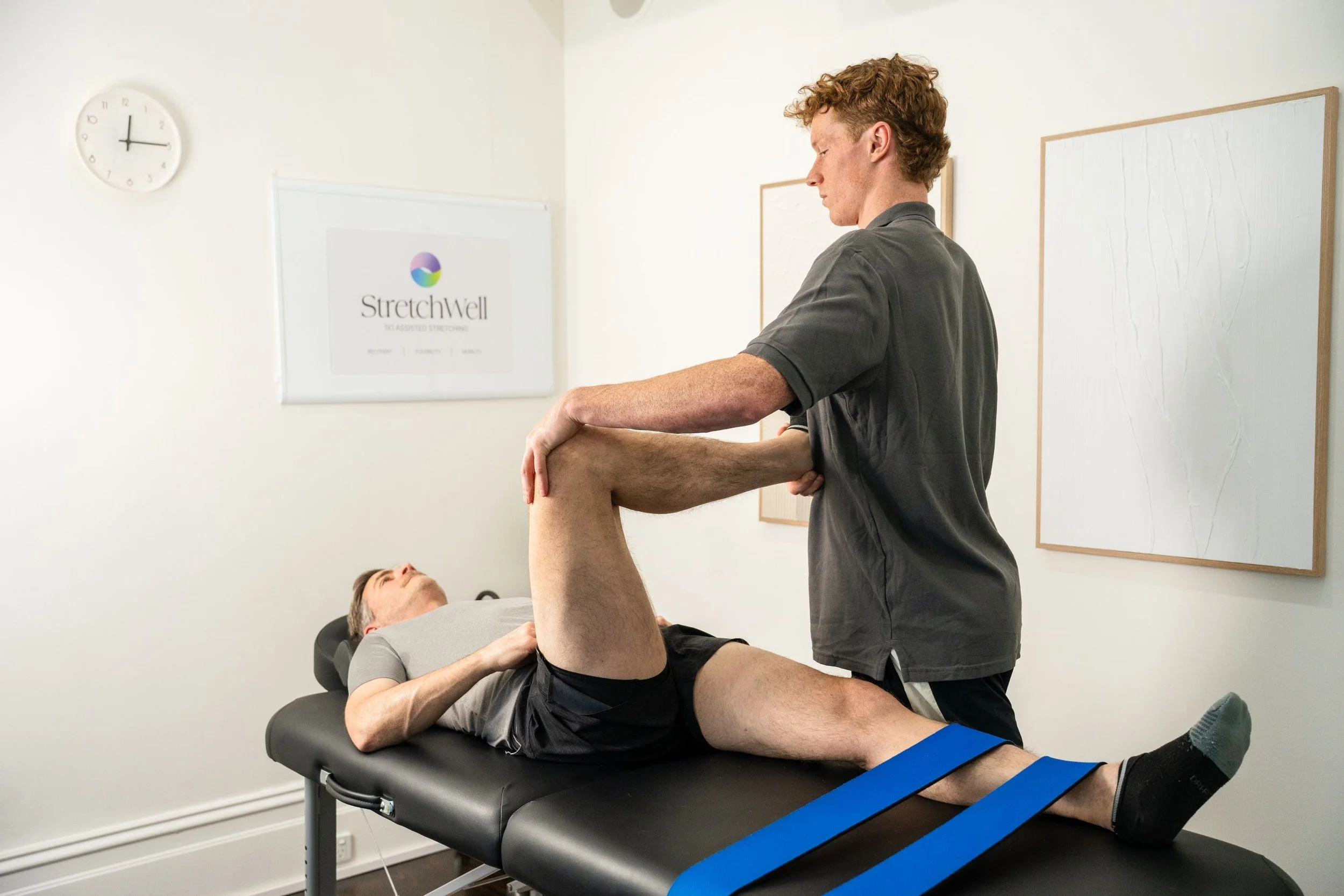
In a session at StretchWell, a trained therapist moves you through each stretch while you lie back and relax. Because you're not working to hold the position, your muscles can let go further. Your therapist can also use techniques like contract-relax (PNF) stretching to help you gain range safely.
Better rotation, more consistent swings. We focus on the areas golfers struggle with: hip rotation, upper back mobility, hamstrings and shoulders. More range in the right places means you can make a full turn without your body fighting you, and repeat it more easily.
Faster recovery after a round. Eighteen holes means four or more hours on your feet, a lot of walking and a hundred-odd full-effort rotations. A session in the days after a round or tournament helps ease the stiffness so you're ready for your next hit. It also suits golfers who play a couple of times a week. See our sports recovery in Melbourne page for how we approach recovery.
Less strain on your back. When your hips and upper back move better, your lower back doesn't have to do the rotating for them. Many golfers find this is the biggest change they notice.
Tailored to your game. Tell your therapist where you feel restricted or sore in your swing, and the session is built around that. A Targeted Stretch (25 min) is a quick tune-up for hips and lower back, while the Full Body Stretch (50 min) or Ultimate Full Body Stretch (80 min, with Theragun percussion therapy) covers everything from neck to calves.
Assisted stretching isn't a replacement for physio if you're dealing with an injury. But for most golfers it's a simple way to keep the body moving well between lessons and rounds.
Golf, mobility and staying in the game for longer
Golf is one of the few sports people happily play well into their 60s, 70s and beyond. It gets you outdoors, walking and socialising, all things the Better Health Channel links with healthy ageing.
The catch is that we naturally lose some flexibility as we get older. For golfers over 50, that often shows up as a shorter backswing, less distance off the tee and more stiffness the morning after a round.
Regular stretching, and assisted stretching in particular, helps hold on to that range of motion. It can also support balance and steadiness on uneven ground, which matters on hilly courses. If you're an older golfer keen to keep playing for years to come, our healthy ageing page explains how we work with clients over 60.
A simple pre-round and post-round routine
Whether you're teeing off at Northcote Public Golf Course, Yarra Bend, Royal Park or Ivanhoe, a few minutes before and after your round makes a real difference.
Before you play (5 minutes):
A brisk walk to the first tee or a lap of the practice green
10 standing club rotations each way
10 leg swings forward and back, then side to side, each leg
A few half swings with a wedge before you reach for the driver
After you play (10 minutes):
Seated figure four, 30 seconds each side
Half-kneeling hip flexor stretch, 30 seconds each side
Open book, 8 each side
Cross-body shoulder stretch, 20–30 seconds each side
If you want to find a course, club or competition near you, Golf Australia is a good place to start. Then book in for a stretch on your way home.
Golf stretching FAQs
Can stretching really improve my golf swing? Yes, if stiffness is what's limiting you. Better hip and upper back rotation lets you make a fuller turn and hold your posture, which helps with consistency and can add distance. It works best alongside lessons and practice, not instead of them.
Should I stretch before or after golf? Both, but differently. Before your round, use dynamic movements like club rotations and leg swings to warm up. Save longer held stretches for after your round or on rest days.
How often should golfers do assisted stretching? Most golfers get good results from a session every two to four weeks, or weekly in the lead-up to a tournament or after a heavy run of rounds. Our StretchClub memberships make regular sessions easier to stick to.
Why does my lower back hurt after golf? Often it's because your hips or upper back aren't rotating enough, so the lower back takes on extra load. Improving mobility in those areas can help. If the pain is sharp, lasting or runs down your leg, check in with a GP or physio first.
Is assisted stretching good for older golfers? Yes. Sessions are adjusted to your comfort and range, so they suit golfers of any age and flexibility level. It's a gentle way to maintain the flexibility you need to keep playing.
Book a golf recovery stretch in Northcote
If your swing feels stuck, your back aches after a round, or you just want to keep playing well for longer, we'd love to help. StretchWell is at 108 High St, Northcote, an easy trip from Brunswick, Thornbury, Fitzroy and the rest of the inner north.
Let us know you're a golfer when you book and we'll tailor your session to your swing.
Related Posts